I spent two years blaming the wrong things. Here’s what was actually happening to my face.

my face just looked tired.
That’s the only way I can describe it. Not bad. Not broken. Just tired in a way that wasn’t going away, no matter what I did. And honestly, for the first two years, I had nothing else to blame other than the climate.
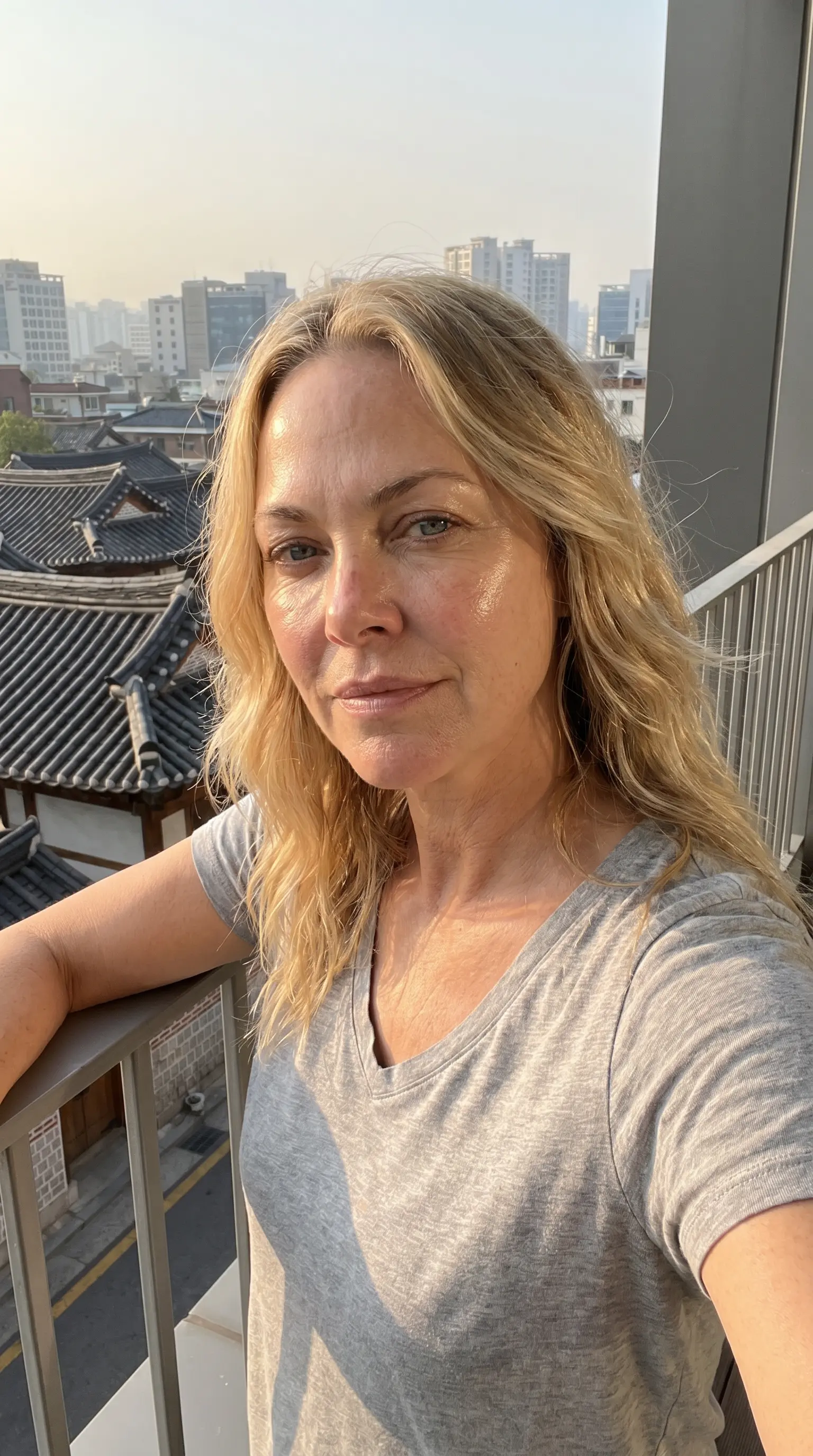
I was 33 when we moved to Dubai. New job, new house, new chapter. Everything else about our life there was working out beautifully. The only thing that wasn’t working was my confidence, because my skin had taken a dive and I couldn’t figure out why.
It started small. My skin felt drier than it had ever felt. It looked a little darker in the mirror. It felt thinner under my fingers when I’d wash my face at night, like the soft layer that had always been there had been quietly traded for something else. I’d always had good skin. It runs in my family. My mom has it. My aunts have it. I used to hear compliments about it from people I barely knew. I never thought about it. I just always had it. And now I was looking in the mirror and I couldn’t find it.
I tried to ignore it for a few months. I told myself I’d adjust to the dry air. I told myself the new water was a phase. I told myself I was just exhausted from the move, that of course my skin would look this way after the year I’d had, and that it would settle once I settled.
Then one morning my husband, who was my boyfriend at the time, asked me if I was okay. He said I looked tired. He said it kindly. He didn’t mean any harm. I’m not blaming him. But it was the worst thing I could have heard, because I was already doing everything in my power right. I had the anchors my mom raised me with. I was sleeping eight hours. I was eating clean, mostly whole foods, almost no sugar because I’d always known sugar ages your skin. I was using the same products that had worked for me since I was 22. By every measure I had, I was taking care of myself. And he was telling me I looked tired.
I started to resent the city we’d moved to. And then, for the first time, I let myself ask a different question. What if it wasn’t the place? What if it was stress? What if all of this, the move, the new job, the new everything, had taken more out of me than I’d let myself admit, and my face was just where it was showing up?
I started with my doctor. She told me to do yoga and drink more water. I’m not exaggerating. That was the entire conversation. So I called my mom next. She told me to try Yin Yoga specifically, the slow kind where you hold the poses and stack your hips above your heart and let your nervous system come back down. I started drinking a gallon of water a day. I started walking ten thousand steps. I made myself move my body, slowly and on purpose, every day.
And it worked. Not for my skin. For everything else. I have never felt more relaxed in my life. I felt grounded. I felt present in conversations I’d been half-checked-out of for a year. Almost every other part of my life got better in the three months I spent doing this.
Except my skin.

My stress was gone. My skin was the same.
That’s when I knew it wasn’t stress either.
This is the part almost no one tells you.
so i went looking.
Not 2am-google looking. Real looking. I read every paper I could find on women’s skin and aging, which is its own depressing rabbit hole because most of the research is about men’s skin or teenage acne. But I found one. Dr. M. Julie Thornton, a skin biology researcher at the University of Bradford in the UK, had spent more than two decades studying exactly what changes in women’s skin in their late thirties, and what was driving it.
Her answer was estrogen.
Most of us think about estrogen as a reproductive hormone. It is. But that’s not all it does. Estrogen, it turns out, had been running my skin for most of my adult life. It was doing four specific things, every day, and I’d never known about any of them.

It built my collagen.
Collagen is what gives skin its bounce and structure. The thing that makes a face look full instead of drawn. Estrogen was telling my skin to keep producing it, and my skin was listening.
It held water inside my skin.
Not “moisturized.” Held. The hormone was signaling for the structures in my skin that bond with water to keep doing their job. That’s why I’d never thought about hydration before. My skin had been managing it for me.
It maintained my barrier.
The protective oils on the outside of skin are the reason it doesn’t react to weather, dust, fragrance, sunlight, or every product you put on it. Estrogen was telling my body to keep that barrier intact. As long as the signal was running, the barrier ran.
It calmed my skin down.
When skin gets reactive, something has to bring it back to baseline. Estrogen was doing that, quietly, every hour of every day.
Four jobs. One hormone. And nobody had told me that.
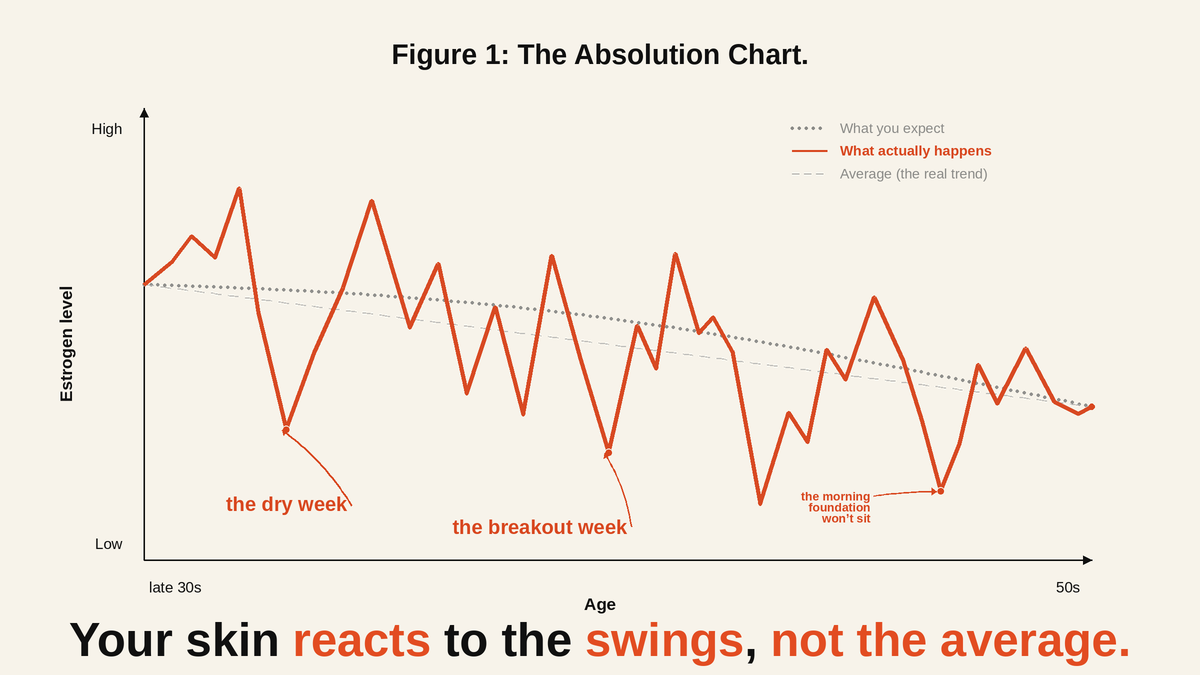
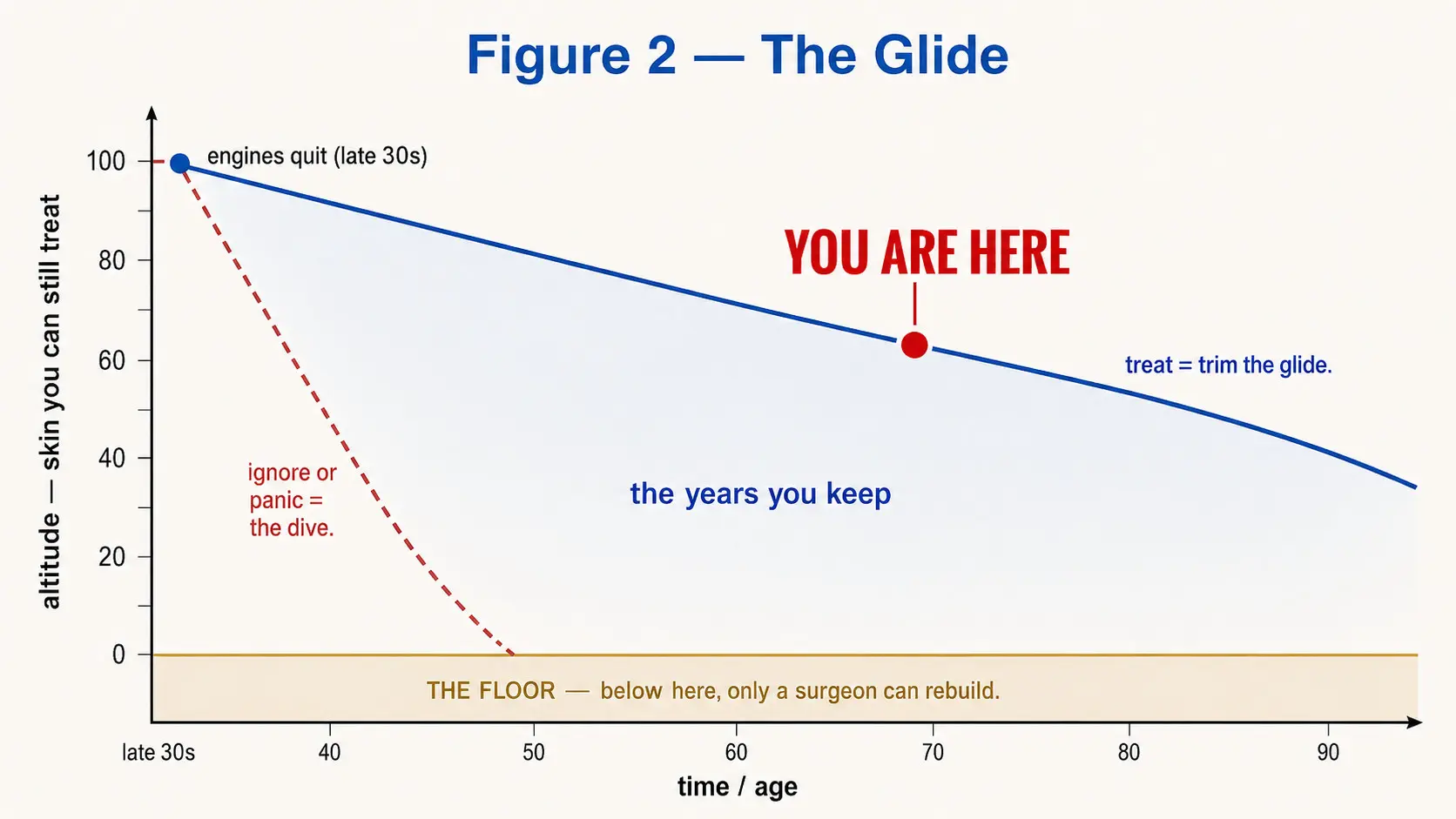
Dr. Thornton’s next finding was what stopped me. Around age 35, sometimes a few years earlier, estrogen quietly starts to leave. It doesn’t disappear all at once. It drops. Slowly at first. Then in cliffs.
In the five years after 35, women lose roughly 30% of the collagen in their skin. The first major cliff hits between 40 and 44. A second one hits between 50 and 55. Most women have no idea this is happening to them. They just know their skin has stopped behaving the way it used to.

Aging, the paper said, isn’t a slope. It’s a staircase. The first stair is at 40.
i closed the paper and went straight to my bathroom cabinet.

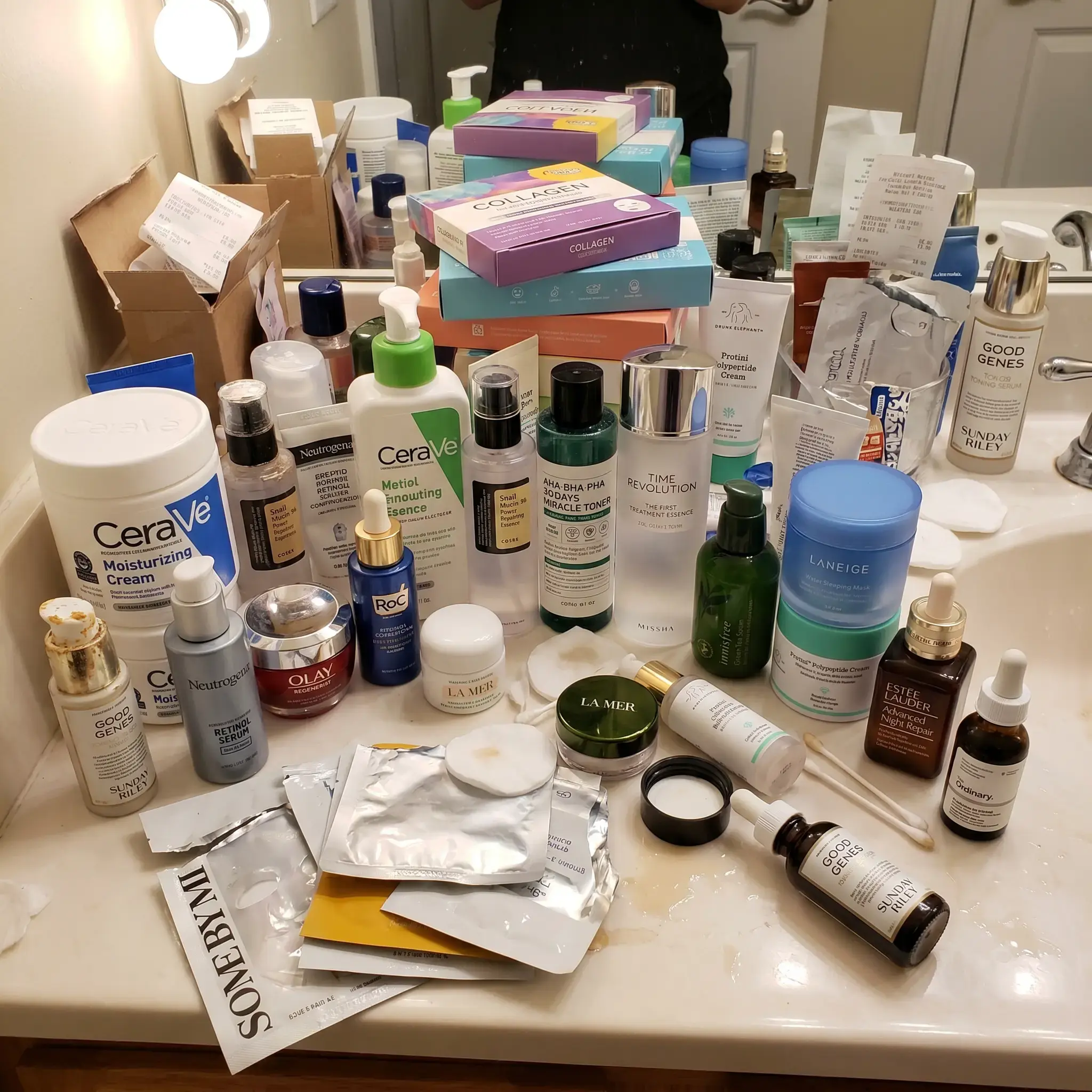
I stood there looking at it. Two distinct shelves. On the top, the products I’d been loyal to since college. The cleanser, the moisturizer, the SPF, the retinol I trusted, the serum that had aged with me. Familiar. Reliable. Doing what they’d always done.
And on the bottom shelf, a different cabinet entirely. The panic-buys. The sheet masks I’d added when my skin started feeling tight. The $80 serum I’d switched to. The $200 cream I’d handed my husband a receipt for and felt sick about. All bought in the last two years. All trying to fix the same thing. None of it working.
I’d been looking at it backwards.
My core routine wasn’t the problem. It was doing exactly what it was built to do. Every product up there was working at the surface, which is where surface products work. The problem was that the surface wasn’t where the change was happening. The change was happening underneath, in the four-function factory I’d just read about. And nothing in my cabinet had ever been designed to reach it.
Retinol speeds up turnover.
That’s its job, and it’s still doing it. Turnover wasn’t the missing function. The barrier was.
Sheet masks deliver actives in water for a few minutes.
Surface delivery. Not designed to reach the deeper work that needs time and seal.
Serums slide across the surface.
Built for surface, not depth. Useful, but not for what was actually happening.
The $200 face cream propped up the surface barrier.
It did its job on its terms. But a barrier that’s lost its underlying signaling needs to be rebuilt, not just propped up.
That bottom shelf was the graveyard. The panic-buys. None of them had failed because they were bad. They’d failed because nobody had built the thing that could actually reach what was happening underneath.
I didn’t need a different routine. I needed something my routine was never designed to do.

if estrogen had been doing four things, then anything that was going to genuinely help me had to do all four.
Topically. From the outside.
I sat with that for a few days and made myself a list.
Refill.
Something had to put water back into my skin in a way it could actually hold onto. Not splash it on. Bond it in.
Reseal.
The barrier estrogen had been maintaining was thinning. Whatever I used had to reinforce it with the structure my body wasn’t producing the same way anymore.
Rebuild.
Collagen loss was what was draining the bounce out of my face. The product had to deliver collagen in a form that could actually reach where it was needed, not sit on top.
Calm.
A thinning barrier is a reactive barrier. Whatever the product was, it had to bring the inflammation down too, not just leave my skin to handle it.
Four jobs. From one product. That was already asking a lot.
But the more I read, the more I realized that wasn’t even the hardest part. The hardest part was the format. Because most actives can’t reach the layers where they actually need to work. Collagen, hyaluronic acid, anything bigger than a small molecule. None of it can get there in the ten minutes a moisturizer sits on your face before it absorbs or evaporates. They need time. They need to stay in contact with the skin long enough to be drawn down, not whisked off.
And they need a seal. Water-based products lose their actives to evaporation. A real fix had to keep the actives pressed against my skin without letting them escape into the air around me.
So I narrowed down what I was actually looking for.
Time in contact. A real seal. Molecules sized small enough to actually go where they were needed. And four functions in one delivery.
That was a specific kind of product. And the more I searched, the more I realized that kind of product barely existed in American skincare aisles. The category was still mostly a Korean thing. A kind of treatment built for skin that needs more than the surface can give it.
That’s how I found what I found.
i found it on a k-beauty forum, buried in a thread of women in their late thirties trading the same problem.
Not a brand site. Not sponsored content. Just women talking about what had worked for them. The product they kept coming back to was something I’d never heard of. A hydrogel collagen mask called Spruka.
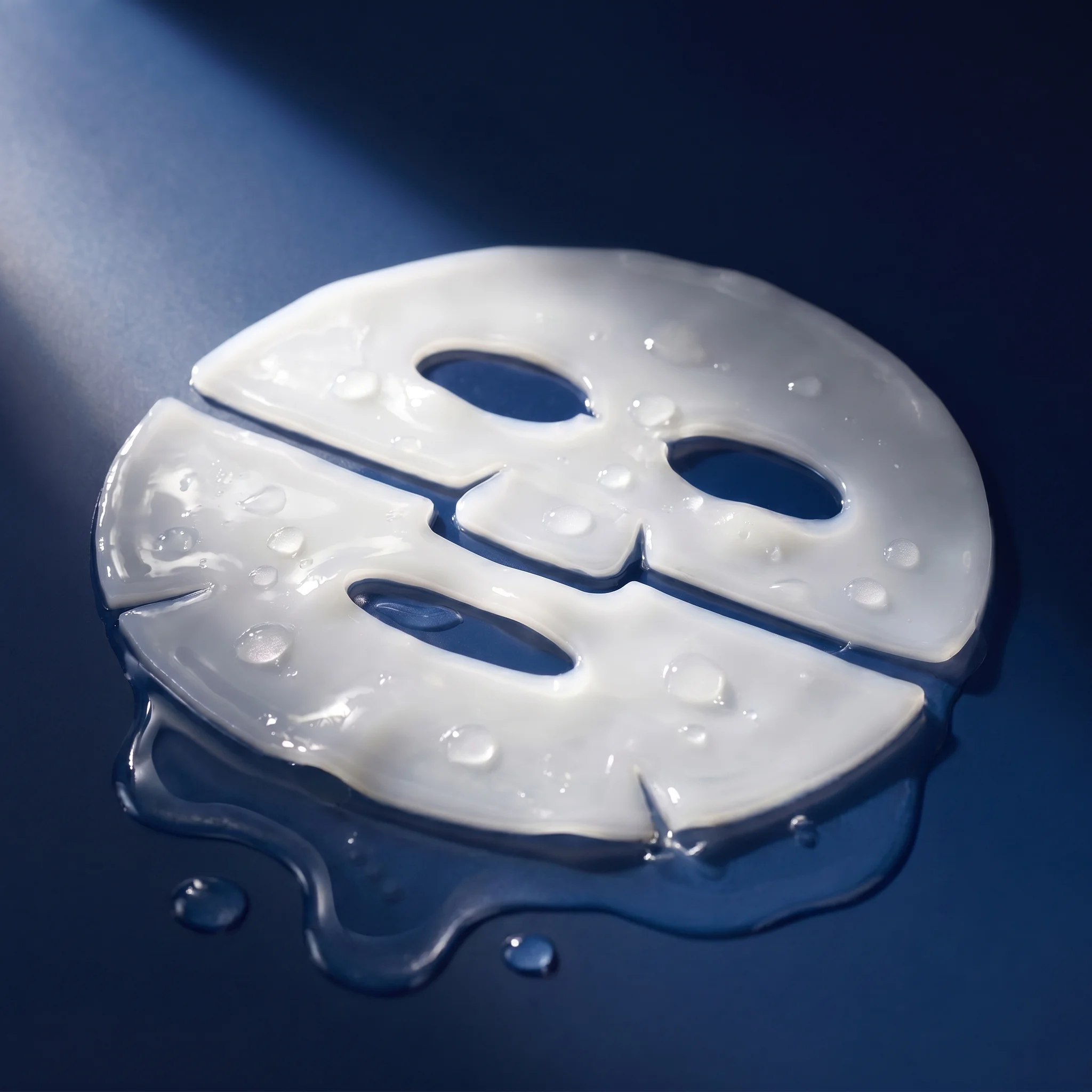
The format was the first thing that caught me. Two thick gel sheets, one for the upper face and one for the lower, designed to stay in place against the skin for 60 minutes. Not eight hours. Not overnight. One hour, during the day, while I did anything else. The hydrogel itself was the seal. It held the actives in direct contact with my skin without evaporation, without slippage, without dilution.
That was the first criterion. Time. And a real seal. Box checked.
Inside the gel were three active ingredients, chosen specifically to address what estrogen had been doing.
Standard collagen sits on your skin’s surface. Ours is broken down small enough to reach the layers that actually plump.
Plump
Hydrolyzed small enough to pull moisture into the skin, not just hold it on top. The result is a dewy look that lasts 100 hours.
Hydrate
The K-beauty ferment legacy, distilled. Refines texture, evens tone, reveals the glass finish.
Glow
Three ingredients. Four jobs. One hour of contact, twice a week.
And here is what I want you to understand. Spruka wasn’t a replacement for what was already in my cabinet. It wasn’t a new daily routine. It wasn’t a cleanser, a moisturizer, an SPF, or a retinol. I kept all of those. They were still doing the work they’d always done.
Spruka was the deep treatment slot I’d been missing. The thing my routine had never been designed to do. Sixty minutes, twice a week, while I worked or read or sat with my husband. The rest of my routine stayed exactly the same.
That’s the entire system.
i ordered it that night.
It arrived a week later. Two thick gel sheets in a foil pouch, exactly like the forum had described. I read the instructions twice. Wash your face. Pat dry. Apply the upper sheet, then the lower. Press into the contours. Wait 60 minutes.
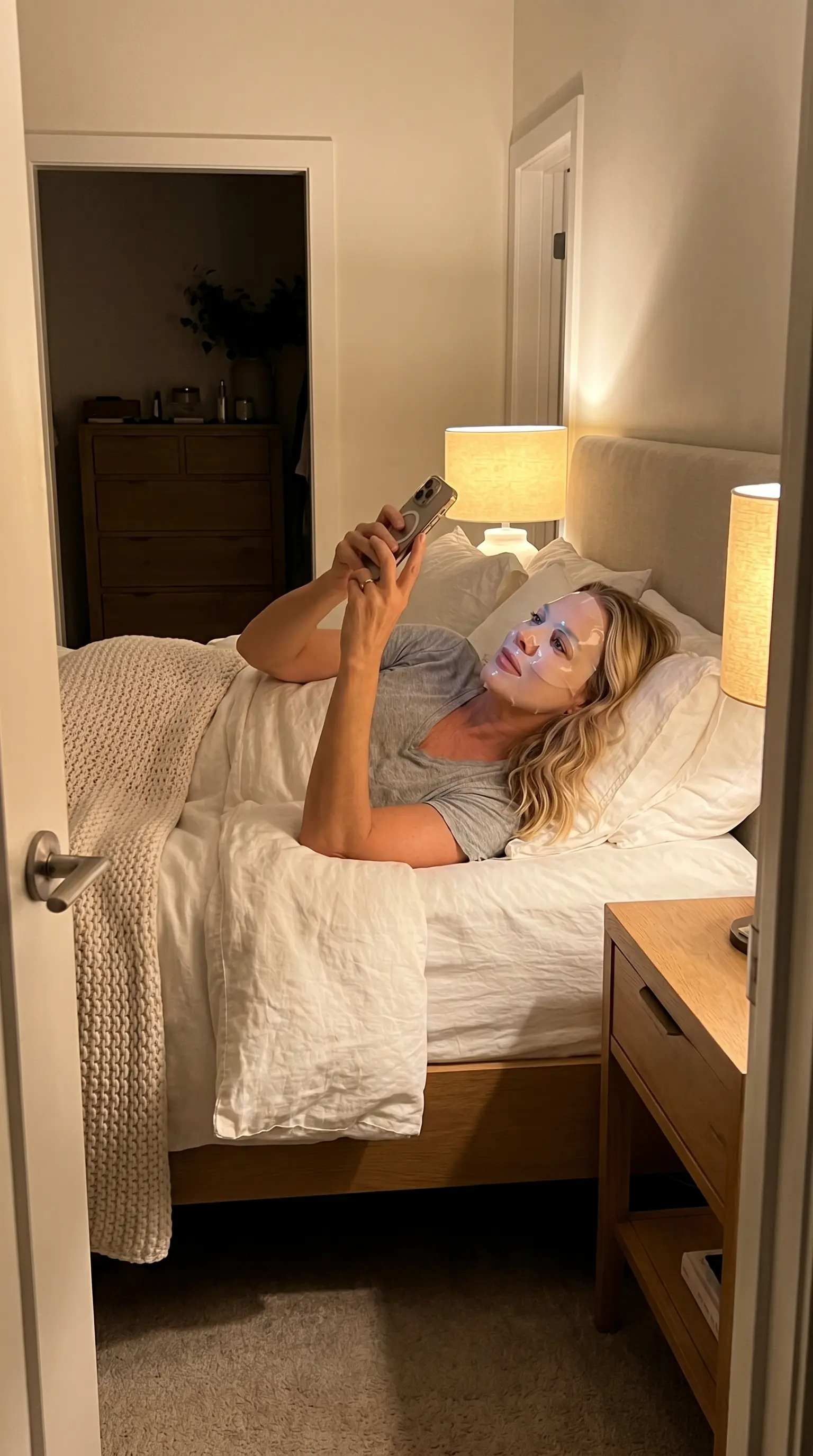
I did it on a Sunday afternoon. I lay on the couch with a book. I forgot it was on for the first twenty minutes. The sheets stayed in place. Nothing slid. Nothing dripped. After 60 minutes I peeled them off and looked in the mirror.

My face was holding onto water in a way it hadn’t in months. The flaking on my cheeks had quieted. The tightness around my jaw was gone. Foundation went on smoother that day and the day after.
By the second use, the bounce was starting to come back. The hollow look that had moved in around my eyes was softening. The skin on my forehead was responding to touch differently. Less reactive. More my own.
By the fourth use, I knew. The changes were compounding. The barrier was stabilizing. The reactivity was fading. The mirror was giving me back the face I remembered, not the one that had been surprising me every morning for two years.
I wasn’t reversing what was happening underneath. Spruka doesn’t fix the estrogen drop. It can’t. What it was doing was taking over what estrogen had been doing for my skin. Sixty minutes, twice a week, while my body figured out the rest.

That was the first time I felt like myself again.
after three weeks, i went back to the forum i’d found spruka on.
I scrolled through every thread. Hundreds of women in their late thirties and early forties, all describing the same arc I’d just been through. Different climates. Different jobs. Different starting points. Same trajectory.

It’s backed by a 60-day money-back guarantee. If your skin doesn’t respond the way mine did, the way these women’s did, you send it back. No questions.
That’s the deal.
if you’ve spent the last year or two blaming the wrong things for your skin, this is the part where you stop.
Glass skin in 60 minutes. Twice a week. While the rest of your routine keeps doing what it’s always done.
Check Availability60-Day Money-Back · Free Shipping over $50 · Developed and Designed in Korea
We didn’t just make a mask. We made a confidence booster. One that helps you look better in photos, feel proud of your reflection and get compliments that make your day.
If you don’t feel it lives up to the promise? Send it back. We’ll refund you in full.
How often do I use Spruka?
Twice a week. Sixty minutes per session. That’s the entire system. You can use it during the day while you work, read, or sit on the couch.
Will Spruka replace my current routine?
No. Spruka is added to your routine, not a replacement for it. Your cleanser, moisturizer, SPF, and retinol still do the work they’ve always done. Spruka fills the deep-treatment slot your routine was never designed for.
How long until I see results?
Most women notice a difference in hydration and texture after the first use. By the fourth use, the barrier starts stabilizing and the bounce begins coming back. Full compounded effects typically appear within 4 to 6 weeks of consistent use.
Is Spruka safe for sensitive skin?
Yes. The Galactomyces Ferment Filtrate is specifically calming, and the formula is hypoallergenic and dermatologist-tested. If you have a history of reactivity, patch test for 24 hours before the first full application.
What’s in the box?
Each mask comes as two hydrogel sheets, one for the upper face and one for the lower. A single pack contains 4 masks, which is enough for 2 weeks of treatment at the recommended twice-weekly use. Larger bundles cover 6 and 12 weeks.
What if it doesn’t work for me?
60-day money-back guarantee. Use the masks. If your skin doesn’t respond, send the box back inside 60 days for a full refund. No questions.
Shipping?
Free shipping on orders over $50. Subscription orders always ship free. Ships from a US warehouse, typically arrives in 3 to 5 business days.